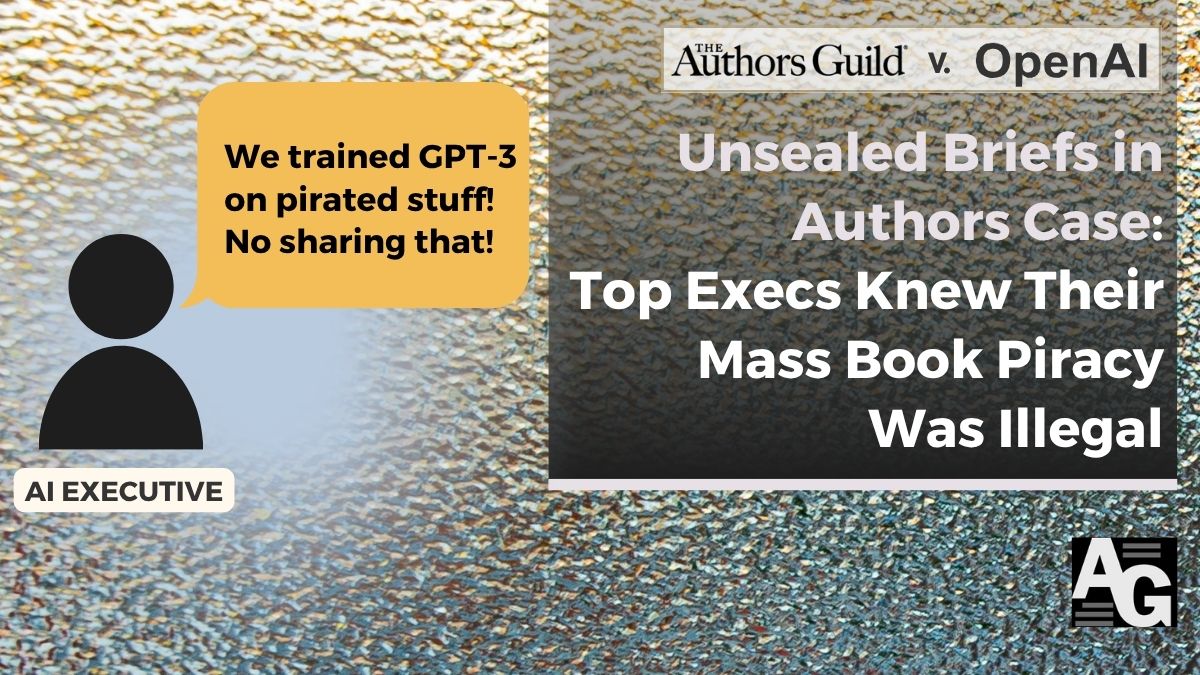
Newly unsealed court briefs in Authors Guild v. OpenAI and Microsoft allege that executives and employees at both companies knowingly broke copyright law and showed disregard for human authorship, according to a press release from the Authors Guild published on September 21, 2026. The documents were released last Thursday in the closely watched lawsuit over whether OpenAI and Microsoft illegally trained their AI products on copyrighted books.
The filings quote internal communications that reportedly describe using books from a "sketchy Russian website" and releasing products "that will make people unemployed." The brief also warns that "OpenAI's GPT models pose an existential threat to those who write and publish books." The case, formally titled Alter v. OpenAI and Microsoft, is part of a broader multidistrict litigation pending in Manhattan.
What the unsealed briefs in Authors Guild v. OpenAI reveal
According to the Authors Guild's summary of the filings, the brief documents what it calls AI developers' knowledge of the damage their actions could cause to authors, publishers and American culture. The Guild says the documents show OpenAI pursued a "mass piracy scheme" even when faced with evidence that it would degrade culture and put writers out of work.
The filings are drawn from two documents: Class Plaintiffs' Memorandum of Law in Support of Motion for Partial Summary Judgment (Docket 1982) and Class Plaintiffs' Corrected Rule 56.1 Statement of Undisputed Material Facts (Docket 1987). The Authors Guild describes the briefing as a turning point that puts the defendant companies' knowledge and actions at the center of the case. The organization also noted separate but similar allegations in a brief filed by news media organizations.
Authors Guild v. Microsoft and OpenAI: who is suing and why
The plaintiffs include the Authors Guild alongside writers David Baldacci, Taylor Branch, Michael Connelly, Sylvia Day, Jonathan Franzen, Christopher Golden, Andrew Sean Greer, John Grisham, David Henry Hwang, Matthew Klam, George R.R. Martin, Jodi Picoult, Stacy Schiff and James Shapiro, among others. The class action is brought on behalf of the Authors Guild and book copyright owners, with lead counsel Justin A. Nelson of Susman Godfrey.